The problem
I wanted to see the day’s schedule without opening another app. A calendar on a computer or phone is available when I look for it; I was interested in what changes when the information has a dedicated place in the room.
That led to a product-design question: could a dedicated physical interface make the next appointment easier to notice? I used an e-paper calendar prototype to explore the interaction directly, keeping the scope to the information and behaviour needed for that question.
My role & ownership
Product concept, prototyping, hardware integration & application build
What I built
I connected a Raspberry Pi to an e-ink display and built the application and hardware integration myself. The Python stack used CalDAV to retrieve calendar data, NumPy and Pandas for data handling, and Pillow to render the schedule as an image.
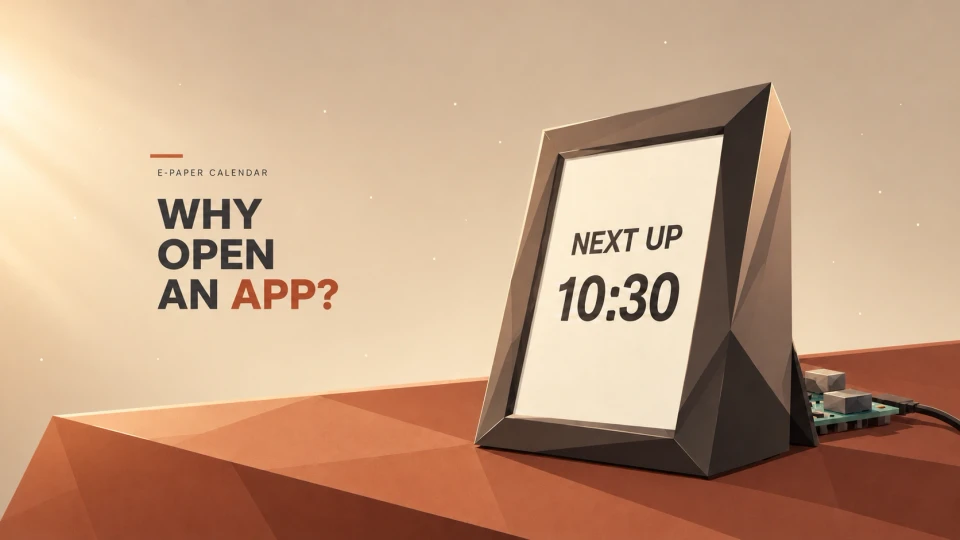
The display shows the daily schedule and advances to the next appointment as meetings end. That progression is the core of the experiment: the displayed information changes with the day rather than remaining a static list that I have to reinterpret.
Challenges & decisions
I kept the scope around one information surface rather than building another calendar application. CalDAV provided the connection to calendar data; the Raspberry Pi and rendering code turned that data into something the e-ink screen could display.
The interesting design choice was what to put in view. A daily schedule gives the display a clear purpose, while moving to the next appointment keeps the emphasis on what comes next. I treated it as a focused hardware-and-software integration exercise, not a commercial product.
Outcomes & lessons
- Displays a daily schedule on an e-ink screen.
- Advances to the next appointment as meetings end.
The result was a personal prototype combining product concept, application development and physical hardware. It reflects how I approach early innovation: translate a user need into a bounded idea, make it tangible and use the build to explore the interaction. Here the evidence is the working schedule-display behaviour; demonstrating a productivity benefit would require further testing.
The evidence supports the build and its schedule-display behaviour, not a measured productivity improvement or a claim of sustained daily use. There is no public repository, commercial deployment, or user-adoption outcome to report. The visual on this page is an illustration, not a photograph of the device.