The problem
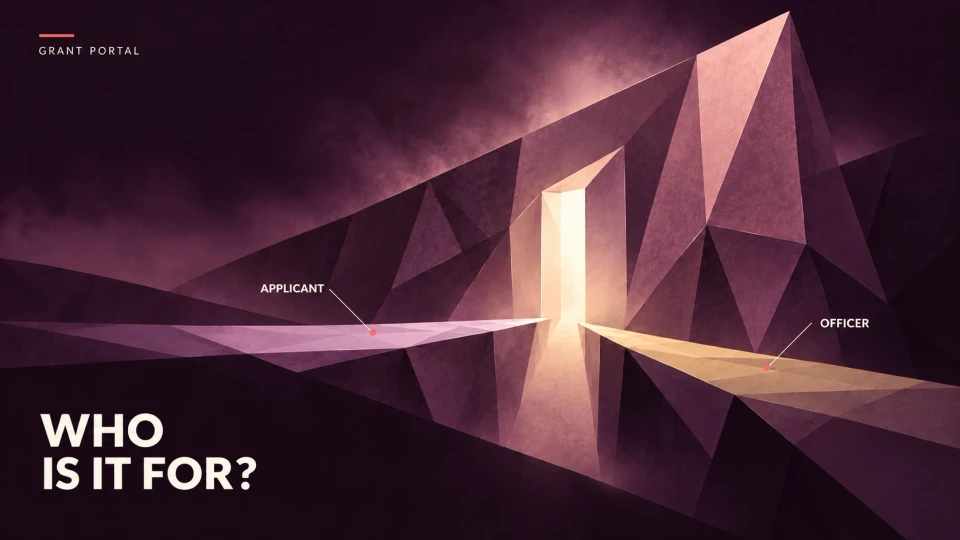
A grant transaction has to work for two groups: the enterprise applying for support and the officers processing the application. Improving the portal therefore meant understanding both the applicant experience and the operational work behind it. A change that looked better on screen would not, by itself, demonstrate a better service.
At Enterprise Singapore, I led this digital transformation work from discovery through pilot. The business context included both access to support and the work of processing applications. I used research with enterprises and officers to shape product requirements, then carried the redesign through prototypes into a tested service experience.
My role & ownership
I managed the redesign lifecycle from product discovery and requirements translation to prototype iteration and pilot delivery. My role was to turn research with two user groups into a service design that could be tested in practice.
I conducted more than 20 enterprise interviews and interviewed grant-processing officers across multiple rounds. These were distinct perspectives on the same transaction: enterprises using the service and officers responsible for processing its work. I led two prototype iterations and one pilot, carrying the research into a revised experience that could be assessed in use.
This was ownership of the redesign and its progression through pilot, not a claim that I independently delivered every part of the wider grant service.
What I designed / delivered
The work moved from interviews to two prototype iterations, then to a pilot of the revised portal experience. I used enterprise and grant-officer research to inform the redesign, keeping the service-facing and operational sides of the transaction within the same product scope.
The prototypes made the redesign concrete before the pilot. Rather than presenting discovery as the final deliverable, I took the work through a sequence that connected understanding the problem, developing a revised experience, and testing it in use.
The pilot supplied the outcome evidence for this case: user satisfaction and a reported improvement in grant-processing time. I keep those measures tied to that bounded exercise rather than presenting them as proof of an organisation-wide rollout.
Challenges & decisions
The central design consideration was that the transaction could not be judged from only one side. Enterprise interviews were important, but so was repeated research with the officers handling grant processing. I kept both groups in scope instead of equating a portal redesign solely with the applicant-facing interface.
I also treated satisfaction and processing time as different signals. One describes users’ assessment of the experience; the other concerns operational performance. Reporting both gives a more useful account of the pilot than relying on either number alone, without assuming that they establish every aspect of service quality.
Outcomes & lessons
- 20+ enterprise interviews and multiple rounds of grant-officer research.
- Two prototype iterations and one pilot.
- 4.8/5 pilot user satisfaction and 20% improvement in grant-processing time.
The pilot recorded 4.8/5 user satisfaction and a 20% improvement in grant-processing time. These are pilot-scoped results, not claims about all grant users or all processing across the organisation.
They are also separate from the grant-processing automation project associated with a reduction from 50 minutes to 5 minutes. I do not attribute that automation result to this portal redesign.
This project demonstrates how I approach product innovation in an established service: understand the business context, translate research into requirements, and use prototypes and a pilot to test the proposed change. Carrying discovery into delivery gave the team evidence about both user experience and processing performance.