The problem
Finding relevant business support is not just a search problem. A company may describe a business need in everyday language, while the available support is organised around grant programmes, supportable activities, eligibility conditions, and policy exceptions. A recommendation can sound plausible and still direct someone towards the wrong support.
At Enterprise Singapore, I worked on two related foundations for better discovery: recommendation logic for the myEnterprise portal, and the knowledge architecture underpinning a grant directory and LLM-based grant recommender. They address a shared product problem, but they are distinct contributions—not one model trained on one combined dataset.
The knowledge challenge was especially important. Policy materials contained relationships that needed to become explicit in the system. Without a reusable structure, common information would be repeated across records, while exceptions could become difficult to distinguish from inconsistencies. The same knowledge also needed to serve operational users and an AI recommendation experience without forcing both into an identical data model.
My role & ownership
I owned the translation from policy context to knowledge design: analysing business rules, defining the grant model and inheritance logic, and designing a separate schema for AI consumption. I worked with product and engineering teams to make those requirements usable across directory, administration and recommendation experiences.
In the portal recommendation work, I designed recommendation logic using behavioural data, defined relevance and adoption targets, and collaborated across divisions on integration. My ownership was the logic, knowledge structures, and product decisions within those workstreams—not sole delivery of an end-to-end recommendation platform or ownership of the whole BizSG initiative.
This is applied AI product and knowledge-system work. I did not train a foundation model, and the behavioural-data figure below is not evidence of LLM training or grant-recommender evaluation coverage.
What I designed / delivered
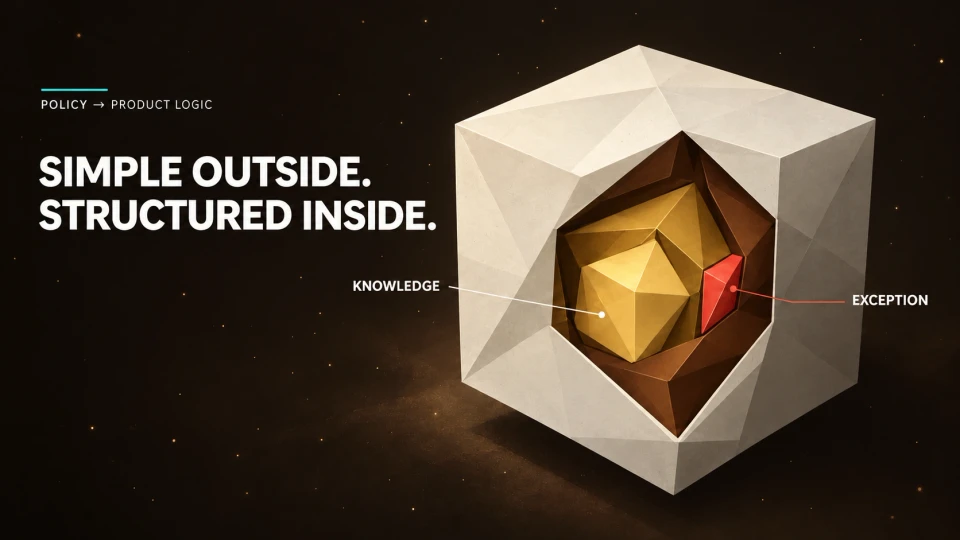
I formalised grant knowledge into a three-level hierarchy:
- Grant programme: the parent policy structure and common information.
- Supportable activities: the activities supported within that programme.
- Pre-approved sub-activities: the more specific activities beneath them.
Cascading inheritance allows information to be defined at the appropriate level and carried down, with explicit overrides where exceptions apply. This preserves the relationship between a programme and its activities rather than treating every item as an unrelated record. It also avoids requiring the same common policy information to be maintained independently in every descendant.
For the LLM-facing layer, I designed a dedicated AI-consumption schema. It combines inherited programme, activity, and sub-activity information with additional context useful to the LLM. The operational hierarchy remains suited to directory and administrative needs; the AI-ready representation serves semantic retrieval and recommendation workflows. The two remain synchronised without having to evolve as the same structure.
Separately, I designed portal recommendation logic using 150,000+ behavioural data points, within a platform supporting 200,000+ SME users. The first number describes data feeding recommendation flows. The second describes the surrounding platform, not users uniquely reached by my contribution. Neither establishes a training-corpus size, a model-performance result, or the scope of the LLM recommender’s nodes.
The related LLM evaluation work addresses another part of the lifecycle: using validated expectations, tests, traces, and issue ownership to investigate and improve recommendation behaviour.
Challenges & decisions
The first decision was how to balance reuse with policy specificity. Flattening every activity into a standalone record would make individual records simple to read but repeat shared information. Treating all children as identical would lose legitimate exceptions. I chose inheritance with explicit overrides: shared rules remain shared, while differences have a defined place in the model.
The second decision was to separate operational truth from its AI-facing representation. Exposing the raw hierarchy directly to an LLM would make the operational structure dictate the recommendation context. Maintaining completely independent copies would create a different risk: knowledge drifting between the directory and AI experience. Synchronised, complementary models provide a way to serve both needs while preserving the underlying relationships.
I also made the intended success criteria explicit. I defined targets of 70% recommendation relevance and 50% growth in utilisation and user adoption for the portal recommendation work. These were product targets to guide decisions, not measured results. I do not apply them to grant-node evaluation or present them as achieved uplift.
Outcomes & lessons
- Designed recommendation logic using 150,000+ behavioural data points within a platform supporting 200,000+ SME users.
- Designed separate operational and AI-consumption knowledge models with synchronised inherited information.
- Defined relevance and adoption targets; achieved improvements against those targets are not claimed.
My contribution established a structured grant knowledge architecture, an AI-ready schema, and data-informed recommendation logic within a wider cross-functional product effort. These capabilities contribute to the broader BizSG context, without implying that I owned the entire platform.
The evidence supports the delivered designs and the scope of the recommendation inputs. It does not establish an achieved relevance percentage, adoption increase, feature-specific user count, or quantified maintenance saving.
The work shows how business-to-technical translation becomes a product capability. Policy context determines what a useful recommendation means; knowledge architecture determines what the system can represent; and product targets guide what to evaluate. For applied AI, these design decisions shape the service before a model generates an answer.