The problem
A business diagnostic toolkit is more than a questionnaire. It connects a business problem to questions, assessment logic, scores, interpretation, and a useful next step. Making the form is only one part of making the diagnostic work.
For MOAT — Mother of All Toolkits, developed during GovTech’s {HACK} Hackathon, we explored whether non-technical business users could describe a diagnostic in natural language and use AI to help turn it into a working assessment experience.
The opportunity had two sides: make toolkits easier to create and maintain, and make the experience of completing them less fragmented. Instead of asking someone to navigate a collection of separate forms, the product concept could identify relevant diagnostics through conversation and bring the resulting insights together.
My role & ownership
I was the Product Owner and Problem Statement Owner, representing the business use case. I owned the product vision, translated operational needs into requirements, and worked with the developers to keep the prototype anchored to real workflows.
My contribution was product direction and business-to-technical translation, not sole implementation of the prototype. The developers built the technical solution; I helped define what it needed to accomplish, clarified requirements as questions emerged, and assessed whether proposed features would be useful and feasible.
What I designed / delivered
Define the whole diagnostic, not just its questions
I framed the toolkit-builder concept around the assessment lifecycle: questionnaire and interview flow, business logic, computation and scoring, assessment methodology, insight generation, and the final report.
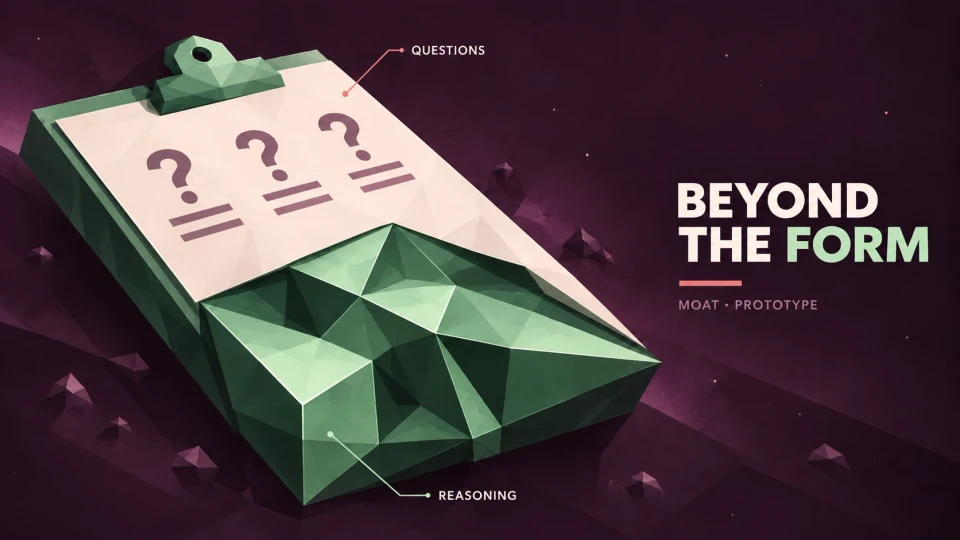
That scope mattered because a fluent set of generated questions would not, by itself, constitute a useful diagnostic. The product needed a coherent connection between the information collected and the interpretation it produced.
Shape a conversational assessment experience
The end-user concept moved beyond one static toolkit at a time. A conversational interface could help establish which diagnostics were relevant, conduct multiple assessments within a conversation, and consolidate the resulting insights into actionable guidance.
This was the product direction explored by the prototype, rather than evidence of a fully deployed toolkit platform or validated diagnostic accuracy.
Keep requirements active during development
Throughout the hackathon, I refined requirements as stakeholder and developer feedback emerged. I provided product clarification, reviewed proposed workflows, and prioritised against business value, usability, technical feasibility, and adoption potential.
The work was iterative: a requirement needed to be understandable to the engineering team, but it also needed to survive contact with the way business users would actually create and deliver an assessment.
Challenges & decisions
Outcomes & lessons
- Defined the business problem, product vision, and requirements for an AI-powered diagnostic-toolkit prototype.
- Guided developer decisions and validated proposed workflows against business needs throughout the hackathon.
- Received strong stakeholder interest in further development; production deployment and measured adoption are not established.
The prototype received strong recognition from business stakeholders and interest in developing it towards a production-ready product. That is an encouraging prototype outcome, not a claim of production rollout, adoption, or measured efficiency gains.
MOAT demonstrates the part of AI product innovation I owned: defining the business opportunity, translating intent into requirements, making priorities explicit and validating the proposed workflow with stakeholders and developers. Active product ownership gave the team a way to resolve uncertainty as the prototype took shape.
A compelling AI interaction is a starting point. The product becomes useful when the workflow and underlying reasoning hold together.