The problem
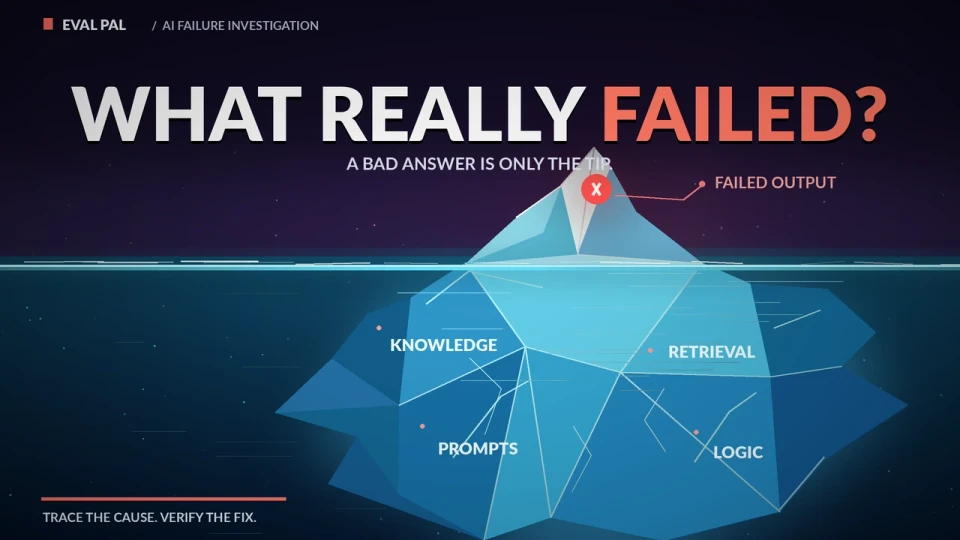
A failed LLM recommendation is a starting point, not a diagnosis. In a multi-node system, an unhelpful answer could come from missing policy knowledge, retrieval behaviour, a prompt, a transformation, or recommendation logic. Scoring the final response tells us that something needs attention. It does not tell us what to change or who should change it.
At Enterprise Singapore, the technical capabilities existed, but the operating workflow was fragmented. Cases moved through recommender runs, CSV exports, product-team annotation, domain-owner review, golden-dataset updates, automated tests, and trace investigation. Each handoff risked losing context or creating another version of the same case. Business reviewers also faced developer-oriented tools exposing far more configuration than their work required.
The business need was a usable way for product and policy reviewers to act on AI failures. I translated that need into an internal product covering the evaluation-to-remediation loop, with requirements shaped around reviewers’ tasks and the technical teams’ investigation needs.
My role & ownership
I designed and built Eval Pal, taking responsibility for product and workflow design, hands-on application development, and integration architecture. The work connected business requirements with component-level and end-to-end AI evaluation, including how reviewers would investigate a case and how teams would own the next action.
This was not ownership of every underlying technology or every fix. Promptfoo provided evaluation capabilities; Langfuse provided tracing. Product teams performed initial review and triage, domain owners validated policy knowledge and expected responses, and technical teams addressed system issues. I designed the workflow that connected those responsibilities rather than trying to replace them with automation.
I also designed the infrastructure workaround needed to make the application function within the available government environment. That establishes my ownership of the application and integration approach, not ownership of the government infrastructure itself.
What I designed / delivered
Eval Pal brings annotation, test-case and golden-dataset management, individual and suite execution, result review, prompt tuning, knowledge-base work, tracing, and relevant logs into one workspace. CSV import and export remain available for bulk work, offline review, and interoperability, without making spreadsheets the primary integration mechanism.
The working loop is deliberately explicit: review an output, annotate the issue, validate the expected behaviour with a domain owner, maintain the test and assertions, run evaluation, inspect the relevant trace, assign remediation, and rerun regression tests. A content correction and a prompt change take different ownership routes, but both return to verification.
Evaluation combines task-appropriate deterministic checks, custom or LLM-as-a-judge assessment, and human annotation. I treated these as complementary evidence. A semantic relevance score helps assess generated language; a domain expert establishes whether an expected answer correctly reflects policy. Neither substitutes for investigating the component that produced the failure.
The architecture connects a locally hosted Next.js frontend to middleware on Government Commercial Cloud and a government Databricks Lakehouse. Rabbitdeploy supports backend deployment. The Lakehouse stores shared test cases, runs, annotations, conversation history, and review imports so collaborative work has shared assets rather than disconnected local copies.
Challenges & decisions
My central product decision was to expose fewer controls than the underlying tools. A reviewer needs to inspect a case, understand the issue, correct relevant knowledge, and check the result—not learn the full configuration surface of an evaluation or observability platform. The tradeoff is less general-purpose flexibility in exchange for workflows aligned with the team’s actual jobs. Eval Pal integrates Promptfoo and Langfuse; it does not attempt to recreate them.
A second decision was to keep human judgement and issue ownership visible. An automated failure is not automatically a content problem, and a changed golden answer is not automatically a valid fix. The workflow distinguishes content and knowledge issues from prompt, logic, retrieval, orchestration, and broader product issues. Domain validation remains necessary when intended behaviour is unclear.
Infrastructure constraints also shaped the design. Rather than assume a conventional hosting arrangement, I connected a local frontend, cloud middleware, and shared government data storage. The priority was a workable investigative tool within the available environment, not an architecture chosen independently of deployment reality.
Outcomes & lessons
- Component-level and end-to-end evaluation across six LLM recommender nodes.
- 400+ and growing test cases per node; these are per-node counts, not a unique combined total.
- An integrated workflow for annotation, investigation, remediation, and regression testing.
The evaluation work covers six LLM recommender nodes, with 400+ and growing test cases for each node, alongside end-to-end evaluation. These are per-node counts; without establishing whether cases overlap, they must not be added into a claimed unique total.
The policy domain spans 140+ grant policy owners across 20 agencies. That describes the investigative scope, not active Eval Pal users. Eval Pal is an operational internal tool intended for my team’s investigative work; I do not claim measured team adoption, a conventional production rollout, or quantified efficiency or quality improvements.
What I delivered was an application and operating model connecting detection, diagnosis, ownership, remediation and regression testing. For AI transformation, this is a practical product capability: domain knowledge becomes testable expectations, and a failed test becomes a decision someone can act on. The work demonstrates business-to-technical translation through both product design and implementation.
The illustration is conceptual. Internal screenshots, conversations, operational records, source code, and a public demo are not included.